Silencing the Hum: How Envolta's Harmonic Mitigation Strategy Transformed Electrical Health at a Renowned Chemical Industry

Introduction: When the Transformer Hummed Too Loud

There is a sound that experienced plant electrical engineers have learned to take seriously: a low, persistent humming from transformers and bus ducts that deepens over time, punctuated by the irregular failures of capacitors and motor windings. It is the sound of harmonic distortion — a complex electrical problem that, if left unaddressed, progressively degrades every piece of connected equipment until failures become not a question of if, but of when.
At one of India’s renowned chemical industry facilities, this scenario had become a genuine operational crisis. The client was experiencing a constellation of symptoms — transformer humming, bus-duct noise, frequent motor winding burnouts, electronic card failures, and overheating power cables — that were individually disruptive and collectively pointing to a systemic harmonic problem of serious magnitude. Envolta Systems was engaged to diagnose the root cause and deliver a lasting solution.
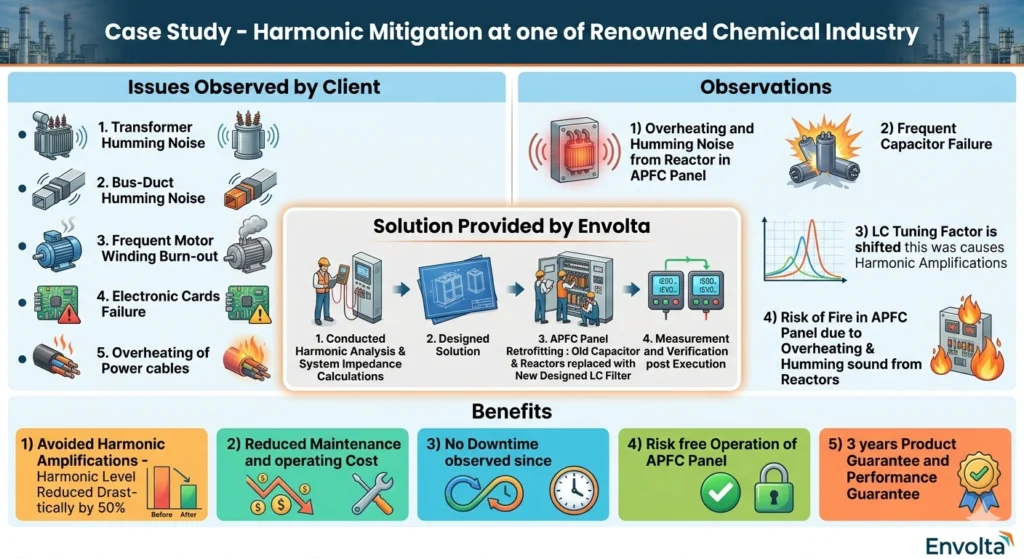
What the Client Was Experiencing: Five Warning Signs of Harmonic Distortion

  • Transformer Humming Noise — a symptom of harmonic flux in the transformer core, indicating that harmonic currents were circulating at levels high enough to cause audible vibration.
  • Bus-Duct Humming Noise — harmonic currents in bus-duct conductors cause mechanical vibration and noise, accelerating insulation fatigue.
  • Frequent Motor Winding Burnouts — harmonic currents cause additional heating in motor windings, significantly reducing insulation life and causing premature failure.
  • Electronic Card Failures — sensitive control electronics are highly susceptible to harmonic distortion in the supply voltage, which causes component stress and failure.
  • Overheating of Power Cables — harmonic currents have a higher effective frequency than the fundamental, increasing cable resistance (skin effect) and generating disproportionate heat.

The Diagnostic Findings: Why the Existing APFC System Was Making Things Worse

Envolta’s engineering team conducted a comprehensive Harmonic Analysis and System Impedance Calculation — not merely measuring the harmonic levels present, but diagnosing the interaction between the existing APFC panel and the plant’s network impedance. The findings were revealing: the existing APFC panel’s capacitors and reactors, which had been operating for some years, had experienced a shift in the LC Tuning Factor. This meant that rather than presenting a high impedance to harmonic frequencies as designed, the degraded components were actually amplifying certain harmonics — a condition known as harmonic resonance, in which the network creates a feedback loop that concentrates harmonic energy rather than dissipating it.

Specific Observations Confirmed by the Audit

  • Overheating and humming noise from the reactor within the APFC Panel — confirming excessive harmonic current through the reactor.
  • Frequent capacitor failures — consistent with harmonic-induced stress on capacitor dielectric materials.
  • LC Tuning Factor shift — evidence that the existing filter components had drifted from their design specifications, causing harmonic amplification.
  • Risk of fire in the APFC Panel due to reactor overheating — a safety hazard demanding immediate action.

Envolta's Solution: A Four-Stage Engineering Response

The solution Envolta designed addressed both the immediate safety risk and the underlying harmonic problem through a systematic, staged approach.

  • Stage 1 — Harmonic Analysis and System Impedance Calculations: Comprehensive measurement and modeling to characterize the harmonic spectrum and identify the specific tuning frequencies required for the replacement LC filters.
  • Stage 2 — Designed Solution: Engineering of custom LC filters tuned to the appropriate harmonic frequencies for this specific plant configuration — not generic off-the-shelf components, but site-specific filter elements calculated to suppress the dominant harmonics without creating new resonance conditions.
  • Stage 3 — APFC Panel Retrofitting: Old capacitors and reactors were removed and replaced with the newly designed LC filter elements within the existing APFC panel enclosure — minimizing infrastructure disruption.
  • Stage 4 — Measurement and Verification Post-Execution: Post-commissioning harmonic measurements to confirm that the installed filters were performing as designed and that harmonic levels had been reduced to acceptable limits.

The Results: Five Compelling Outcomes

  • Harmonic amplifications completely avoided — the new LC filters present the correct impedance at harmonic frequencies, eliminating the resonance condition.
  • Harmonic level reduced by 50% — a dramatic improvement in the plant’s power quality environment.
  • Reduced maintenance and operating cost — with harmonic-induced equipment stress eliminated, the failure rates of motors, capacitors, and electronic equipment have fallen significantly.
  • Zero downtime observed since commissioning — the plant has operated without harmonic-related production disruptions since the retrofitting was completed.
  • Risk-free operation of the APFC Panel — with correctly tuned components and appropriate thermal management, the fire risk has been eliminated.
Additionally, Envolta provides a 3-year Product Guarantee and Performance Guarantee on the installed solution — demonstrating confidence in the engineering quality and durability of the work delivered.

Key Highlights

  • Comprehensive harmonic audit and system impedance analysis before any solution was specified.
  • Custom LC filter design addressing the specific harmonic profile and network impedance of this chemical plant.
  • APFC panel retrofitting — old capacitors and reactors replaced with correctly tuned filter elements.
  • 50% reduction in harmonic levels — a substantial improvement in plant-wide power quality.
  • Zero production downtime since commissioning — the benchmark result of a well-executed harmonic mitigation project.
  • 3-year Product and Performance Guarantee — demonstrating commitment to long-term solution quality.
  • Elimination of fire risk in the APFC Panel through correct component specification and installation.

Expert Insights: The Hidden Complexity of APFC Harmonic Interaction

The scenario encountered at this chemical plant illustrates one of the most technically nuanced aspects of industrial power quality management: the interaction between existing APFC systems and harmonic-generating loads. Many industrial facilities install APFC panels to address power factor compliance without conducting a detailed harmonic analysis. When the harmonic content is high, capacitor banks can create parallel resonance conditions with the network inductance — resonances that amplify specific harmonics rather than attenuating them.
The aging and drift of reactor and capacitor components over time makes this problem progressively worse, as the detuning of a filter that was initially acceptable can eventually create a resonance condition at a particularly harmful harmonic frequency. This is precisely what occurred at this chemical plant, and it is a pattern that Envolta’s engineering team encounters regularly across the industrial sector.

SEO Section: Harmonic Mitigation in Chemical Processing

Search queries relevant to this project include: APFC panel harmonic problem, LC filter chemical plant, capacitor bank harmonic resonance, harmonic audit industrial India, APFC retrofitting harmonics, motor winding burnout harmonics solution. Semantic keywords: power quality chemical industry, harmonic distortion transformer humming, reactor detuning APFC, harmonic amplification industrial, custom LC filter design.

Conclusion: A Lasting Silence — and What It Means

The transformer at this chemical plant no longer hums. The bus ducts are quiet. Motor windings are no longer burning out on a schedule driven by harmonic stress. Electronic cards are no longer failing at anomalous rates. Power cables are running at their designed thermal rating.

This transformation is the practical reality of competent harmonic mitigation — not just measured numbers on a report, but a qualitatively different electrical environment that every engineer and technician on site can feel in the reliability of the equipment they maintain. Envolta Systems delivered this transformation through rigorous diagnostic work, site-specific engineering, and accountable project execution — a benchmark for how harmonic mitigation should be done.

Diagnose and resolve your plant’s harmonic problems with Envolta Systems: info@envoltasystems.com | 9825998879 | www.envoltasystems.com

Envolta Systems is a team of enthusiastic engineers who are driven to offer better engineering, always!

Envolta Systems Pvt Ltd.

TF/24,25, Omkar-2, Nr. GIDC Bus Depot, Ankleshwar - 393002, Gujarat

Envolta Systems Pvt Ltd.

GF/7,8,9, Samanvay Sequence, Manjalpur, Vadodara - 390011, Gujarat.

All Rights Reserved. | © 2024– Envolta Systems | Design By

GET A QUOTE !!

Seeking details about the prices of a business’s goods and services