Ask the finance director of any chemical manufacturing company in India what keeps them up at night, and energy costs will almost certainly feature prominently in the answer. Electricity is one of the largest variable costs in chemical processing — and unlike raw material costs, which fluctuate with commodity markets, energy costs are substantially within the control of a well-managed facility that has invested in identifying and acting on conservation opportunities.
This is the premise behind Envolta Systems’ Energy Conservation Drive: a systematic, engineering-led assessment of a facility’s energy consumption patterns, designed to surface quantified savings opportunities with calculated return on investment — not recommendations in the abstract, but specific proposals with financial projections that management can evaluate and act on. At a renowned chemical manufacturing facility in Vadodara, this approach delivered results that dramatically exceeded the cost of the engagement.
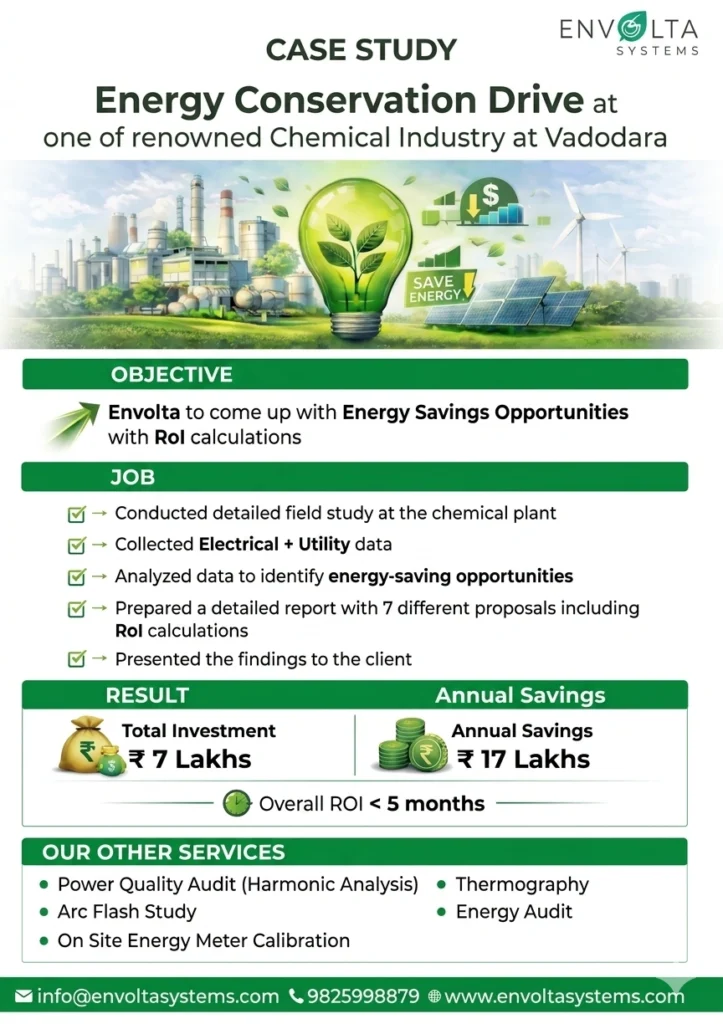
The mandate Envolta Systems received from this chemical industry client was clear: identify energy savings opportunities with ROI calculations. Not a general audit report with broad recommendations, but a focused, quantified investigation that would give management the financial basis to make investment decisions with confidence.
This framing matters. Energy audits that produce long lists of recommendations without financial projections are frequently filed and forgotten. Audits that arrive with specific project proposals, investment requirements, and payback calculations are implemented. Envolta’s approach was designed specifically to produce the latter.
Total Investment Required: ₹7 Lakhs — the combined capital expenditure across the recommended energy conservation measures.
Annual Savings Delivered: ₹17 Lakhs per year — the recurring reduction in energy costs resulting from implementation.
Overall ROI Period: Under 5 months — the time required for the annual savings to fully recover the initial investment.
To place these numbers in context: a ₹7 Lakh investment that generates ₹17 Lakh per year delivers a return of approximately 243% per year on an ongoing basis after payback. In a chemical manufacturing context where investment decisions are frequently evaluated against hurdle rates of 20–30%, an energy conservation project with this payback profile is an exceptionally compelling financial proposition.
While the specific proposals at this facility are proprietary to the client, the categories of energy saving opportunity typically identified in chemical plant audits of this type include: motor efficiency optimization and load-right-sizing, compressed air system leak detection and pressure management, power factor correction and harmonic mitigation, lighting upgrades to LED technology, HVAC and cooling tower optimization, energy metering for accountability and monitoring, and process heat recovery opportunities. Each of these represents a distinct investment with a distinct payback period — and providing them as a menu allows management to sequence implementation based on available capital and operational priorities.
From an industrial energy management perspective, the structured energy conservation study — as opposed to an informal energy review — represents a qualitatively different level of analytical rigour. The formal methodology of data collection, baseline establishment, opportunity quantification, and ROI calculation is what separates actionable savings identification from advisory commentary.
For chemical manufacturing in India specifically, the macro-economic context makes this type of engagement increasingly urgent. Industrial electricity tariffs in Gujarat and across India have trended upward consistently, driven by rising generation costs, grid infrastructure investments, and regulatory changes. A facility that reduces its energy consumption by even 10–15% through conservation measures effectively locks in a cost advantage that compounds every time tariffs increase.
The sub-5-month payback achieved at this Vadodara chemical plant is at the impressive end of the spectrum, but payback periods of 6–18 months are typical for well-executed energy conservation programs in Indian chemical manufacturing — a range that easily clears the investment hurdle rates of virtually any industrial management team.
Key search terms for this service include: energy conservation audit chemical plant India, energy saving ROI calculation industrial, energy audit Vadodara chemical industry, Envolta energy audit services, industrial energy efficiency audit Gujarat. Semantic keywords: energy savings opportunities chemical manufacturing, ROI energy conservation project, electrical data collection industrial audit, power factor harmonic energy audit, energy cost reduction chemical plant India.
For industrial decision-makers who assess capital expenditure proposals by their financial returns, an energy conservation study with a sub-5-month payback deserves serious attention — not as a sustainability initiative, but as a straightforward financial investment with exceptional, recurring returns. Envolta Systems has demonstrated, at this Vadodara chemical facility and across a portfolio of similar engagements, that the discipline of rigorous energy auditing produces exactly this category of result.
The investment in an Envolta Energy Conservation Drive is an investment in knowing where your energy money is going — and in having the engineering expertise to keep significantly more of it.
Start your energy conservation journey today — contact Envolta Systems: info@envoltasystems.com | 9825998879 | www.envoltasystems.com

TF/24,25, Omkar-2, Nr. GIDC Bus Depot, Ankleshwar - 393002, Gujarat
GF/7,8,9, Samanvay Sequence, Manjalpur, Vadodara - 390011, Gujarat.


