In industrial power management, complacency is never truly affordable — and for one of India’s renowned tyre manufacturers, a fire incident inside the air-core reactor of an existing HT APFC panel made that reality unmistakably clear. What followed was not merely a repair job. It became an opportunity for a comprehensive upgrade that would transform the facility’s entire approach to power factor correction.
Envolta Systems stepped in with a complete retrofitting solution — and the results tell a story of restored power quality, enhanced operational safety, and future-ready electrical infrastructure.
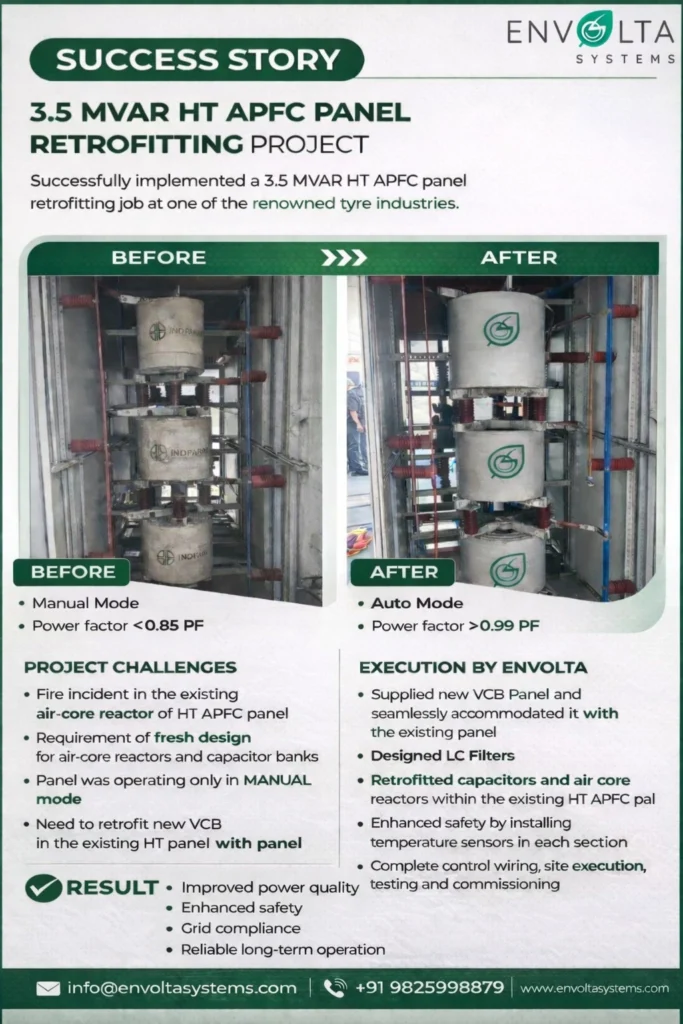
Before retrofitting, the power factor measured below 0.85 PF — a value that typically attracts utility penalty charges and reduces the effective capacity of the electrical infrastructure. Correcting this was not merely a matter of regulatory compliance; it was a direct economic opportunity.
The contrast between the pre-retrofitting and post-retrofitting state is striking — both visually and in terms of measurable electrical performance. The before-state photographs show aging equipment bearing the markings of a third-party manufacturer, operating in manual mode with visible signs of wear. The after-state reveals newly installed Envolta-branded capacitor banks, clean wiring, and a panel now configured for fully automatic operation.
Power Factor Before: Less than 0.85 PF (Manual Mode, reactive penalty risk)
Power Factor After: Greater than 0.99 PF (Auto Mode, full grid compliance)
A power factor of 0.99 is effectively near-unity — the theoretical ideal for reactive power compensation. Achieving this from a starting point below 0.85 represents not only a technical victory but a tangible financial benefit, as utilities typically reward near-unity power factors with lower tariff rates and eliminate penalty surcharges.
High-tension power factor correction is a discipline that sits at the intersection of electrical engineering, financial optimization, and operational risk management. For heavy industries such as tyre manufacturing — which operate large induction motors, compressors, and hydraulic systems around the clock — reactive power demand is substantial and constant.
The decision to retrofit rather than replace an existing HT APFC panel is both technically nuanced and commercially intelligent. Retrofitting preserves switchgear infrastructure, reduces capital expenditure, and minimizes production downtime. However, it demands a higher level of engineering expertise, as the integration of new components with existing infrastructure requires careful impedance matching, thermal analysis, and harmonic assessment.
Envolta’s approach of designing custom LC Filters — rather than installing off-the-shelf capacitor banks — reflects a mature understanding that industrial power systems are site-specific. A filter tuned to the harmonic profile of one facility will not perform optimally in another, and a poor filter design can paradoxically amplify harmonics rather than suppress them. The temperature sensing additions demonstrate that Envolta designed not just for today’s performance but for long-term reliability.
Search queries related to this project type include: HT APFC panel retrofitting, high tension power factor correction improvement, industrial power factor below 0.85 penalty, air-core reactor replacement, VCB panel integration, LC filter design for HT APFC. Industries in tyre manufacturing, chemical processing, cement, and steel sectors frequently encounter these challenges and represent the primary audience for this type of solution.
Semantic keywords of relevance: reactive power compensation, power factor penalty reduction, automatic power factor correction system, industrial electrical panel upgrade, capacitor bank retrofitting India.
The fire incident at this tyre industry client was, in the moment, a significant operational crisis. What Envolta Systems delivered in response was far more than damage control. The completed retrofitting project has left the facility with electrical infrastructure that is safer, more efficient, fully automated, and grid-compliant — a genuine competitive advantage in an industry where energy costs and uptime directly determine profitability.
For industrial facilities still operating ageing HT APFC panels in manual mode, this project offers both a cautionary tale and a compelling blueprint. The cost of inaction — in penalty charges, equipment degradation, and eventual failure — far exceeds the investment in a professionally executed retrofitting solution.
Connect with Envolta Systems to assess your HT APFC panel’s condition: info@envoltasystems.com | +91 9825998879 | www.envoltasystems.com

TF/24,25, Omkar-2, Nr. GIDC Bus Depot, Ankleshwar - 393002, Gujarat
GF/7,8,9, Samanvay Sequence, Manjalpur, Vadodara - 390011, Gujarat.


