Picture this: your plant has invested in energy management software, installed smart sub-meters across every production zone, and tasked your team with tracking consumption department by department. But if the meters themselves are reading inaccurately, every decision built on that data — every procurement negotiation, every efficiency target, every compliance report — is built on a flawed foundation.
Energy meter drift is not a hypothetical risk. It is a documented, measurable phenomenon that affects virtually every industrial facility over time. And yet, regular energy meter calibration remains one of the most routinely overlooked practices in plant maintenance schedules. Envolta Systems is working to change that — with professional, NABL-traceable on-site energy meter calibration services designed to bring accuracy, compliance, and confidence back to your energy data.
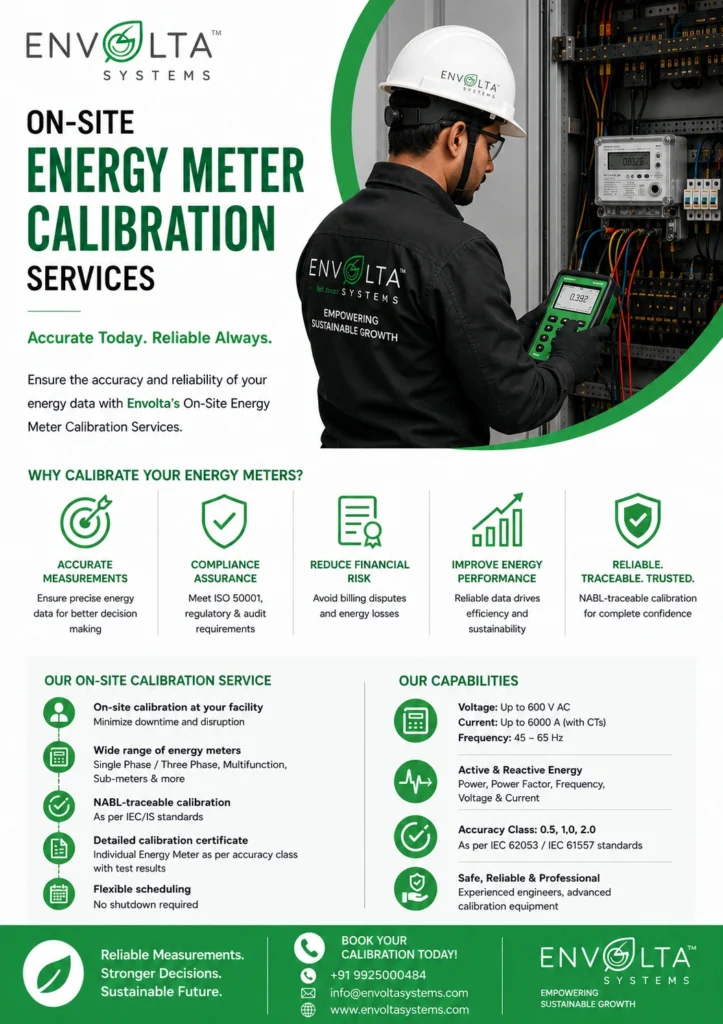
The distinction between sending meters to an off-site laboratory and commissioning on-site calibration is significant — and not merely one of convenience. Laboratory calibration requires meters to be disconnected, transported, recalibrated under controlled conditions, and reinstalled. During this process, metering points go dark, energy consumption data has gaps, and production disruption is often unavoidable.
Envolta’s on-site service eliminates these drawbacks. A qualified engineer arrives at the facility with advanced, NABL-traceable calibration equipment, performs the calibration in situ — typically without any requirement for plant shutdown — and issues a detailed calibration certificate for every meter tested.
NABL (National Accreditation Board for Testing and Calibration Laboratories) traceability is the gold standard for calibration credibility in India. A calibration certificate that is NABL-traceable means the measurement standards used during calibration can be traced through an unbroken chain of comparisons back to national and international measurement standards.
For industrial facilities subject to regulatory audits — particularly those pursuing ISO 50001 Energy Management System certification, BEE (Bureau of Energy Efficiency) compliance, or stringent internal quality audits — NABL-traceable calibration documentation is not merely reassuring; it is often contractually or legally required.
From an energy management consulting perspective, meter calibration is one of the highest-return activities available to industrial facilities — and one of the most consistently underfunded. The reason is straightforward: the cost of calibration is visible and immediate, while the cost of inaccurate meters is diffuse and accumulated over time.
An energy manager who calibrates all plant meters annually and discovers that a critical feeder meter has been over-reading by 1.5% will recover the cost of calibration many times over in corrected billing alone. More importantly, they will have confidence in every energy efficiency project ROI calculation, every sustainability report, and every regulatory submission going forward.
For facilities pursuing ISO 50001 certification, the standard’s Section 9.1.1 on monitoring, measurement, analysis, and evaluation explicitly requires that measurement equipment be calibrated and maintained. NABL-traceable calibration certificates are the most defensible documentation available to demonstrate compliance with this requirement.
Industrial energy managers and plant engineers searching for this type of service typically use queries such as: on-site energy meter calibration service, NABL accredited meter calibration, energy meter accuracy testing plant, industrial meter calibration without shutdown, IEC 62053 energy meter calibration, sub-meter calibration certificate India. Secondary terms include: energy meter drift correction, ISO 50001 meter calibration requirement, three phase energy meter calibration service, power quality meter accuracy testing.
Data-driven energy management is only as reliable as the instruments that collect the data. For industrial facilities that have invested in energy monitoring systems, sub-metering networks, and EMS platforms, the integrity of that investment depends directly on the accuracy of the meters feeding it.
Envolta Systems’ On-Site Energy Meter Calibration Service addresses this foundational requirement with professional precision — delivering NABL-traceable results, comprehensive coverage across meter types and accuracy classes, and flexible scheduling that respects the operational realities of industrial facilities. The tagline says it best: Accurate Today. Reliable Always.
Book your calibration today — call +91 9925000484, email info@envoltasystems.com, or visit www.envoltasystems.com

TF/24,25, Omkar-2, Nr. GIDC Bus Depot, Ankleshwar - 393002, Gujarat
GF/7,8,9, Samanvay Sequence, Manjalpur, Vadodara - 390011, Gujarat.


