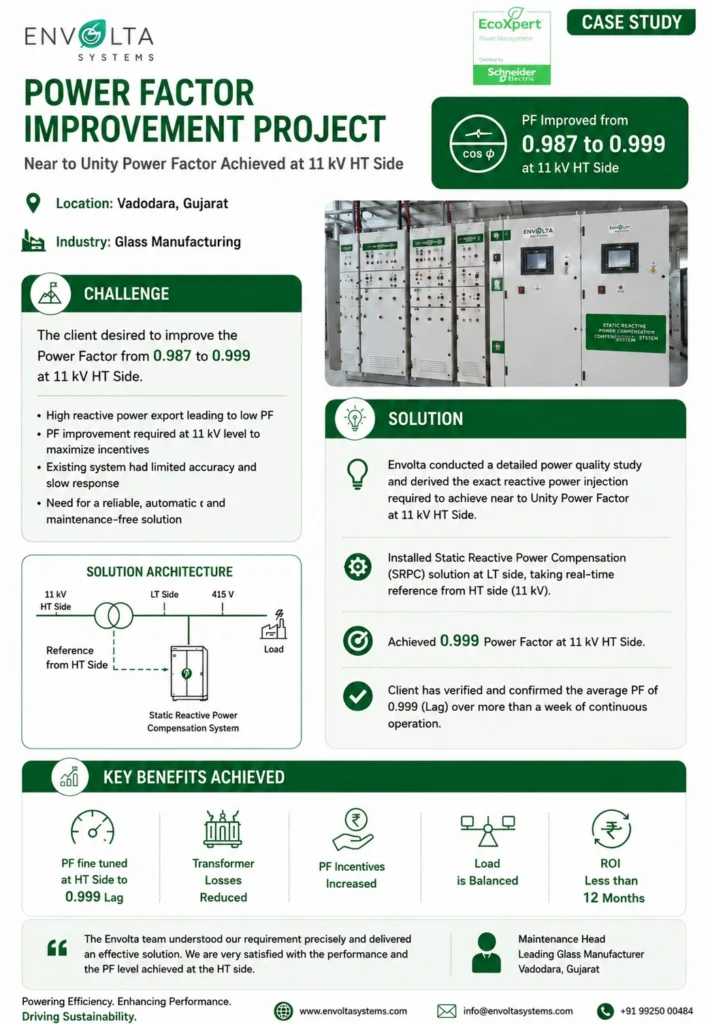
In industrial power management, the difference between a power factor of 0.987 and 0.999 might look small on paper — but on a monthly electricity bill, that gap can translate into real money, real penalties, and real inefficiency. This case study, presented by Envolta Systems Pvt. Ltd. and certified under the Schneider Electric EcoXpert Power Management programme, tells the story of a glass manufacturing facility in Vadodara, Gujarat that refused to settle for “good enough.” The plant set its sights on near-unity power factor at the 11 kV high-tension (HT) side and achieved a remarkable 0.999 lagging power factor, verified over more than a week of continuous operation.
The underlying story resonates far beyond the glass industry: it is about precision, reliability, and the kind of quiet, automated excellence that keeps heavy industry running smoothly. This blog unpacks the case study and explores why HT-level power factor correction is becoming a defining trend for energy-conscious manufacturers across India.

TF/24,25, Omkar-2, Nr. GIDC Bus Depot, Ankleshwar - 393002, Gujarat
GF/7,8,9, Samanvay Sequence, Manjalpur, Vadodara - 390011, Gujarat.


