Stopping the Burnout Cycle: Inside Envolta’s Risk Assessment Study on Electronic Card Failure at a Leading Indian Textile Plant

Introduction: When Replacing the Card Isn’t the Real Fix

Every maintenance engineer knows the frustration of a repeat failure. A drive’s electronic card burns out, gets replaced, and within weeks — sometimes days — it fails again. The instinctive response is to blame the component, the supplier, or bad luck. But at one of India’s leading textile manufacturing facilities, Envolta Systems took a different approach: rather than treating the symptom, the team set out to diagnose the disease.

This case study, delivered under the Schneider Electric EcoXpert Power Management certification, documents a comprehensive Risk Assessment Study into recurring Electronic Card failures. The investigation moved beyond the failed component itself to examine the surrounding electrical environment — harmonics, voltage distortion, resonance, and power factor behaviour — to uncover what was truly driving the failures, and to deliver a prioritised, actionable roadmap for the plant.
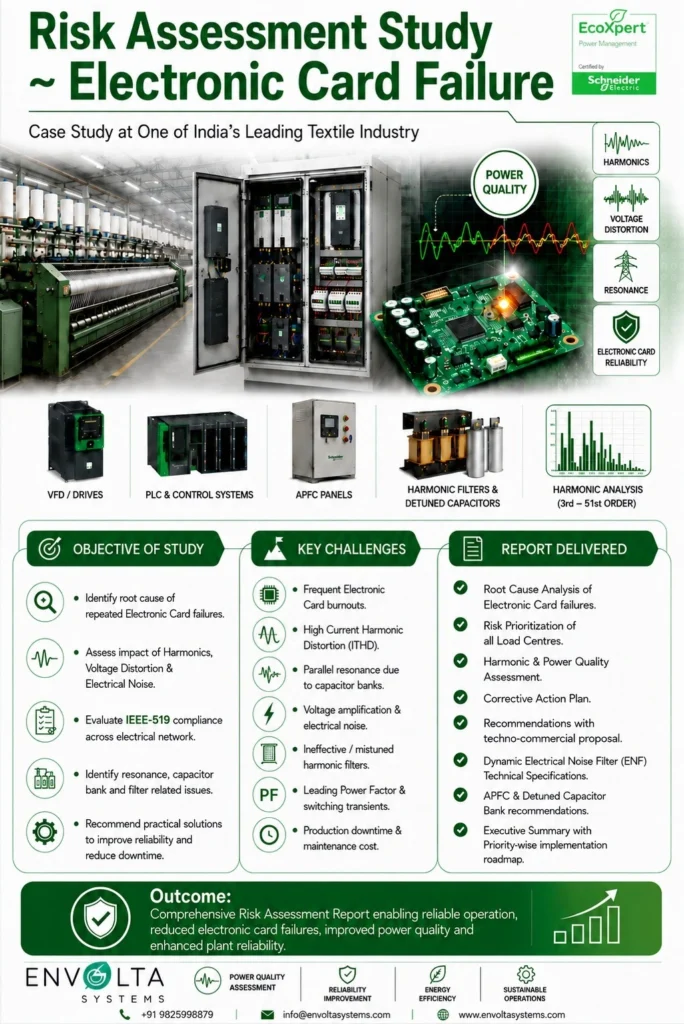
The Objective of the Study

Repeated electronic card failures in a textile plant are rarely random. They are almost always a symptom of an underlying power quality problem that stresses sensitive components every time the plant runs. Envolta’s study was scoped around five clear objectives.
  • Identify the root cause of repeated Electronic Card failures, rather than simply replacing failed units.
  • Assess the impact of Harmonics, Voltage Distortion, and Electrical Noise on the plant’s sensitive control electronics.
  • Evaluate IEEE-519 compliance across the entire electrical network, benchmarking the plant against the recognised international standard for harmonic limits.
  • Identify resonance, capacitor bank, and filter-related issues that may be amplifying — rather than suppressing — harmonic distortion.
  • Recommend practical solutions to improve reliability and reduce downtime, grounded in field data rather than generic best practice.

Key Challenges Uncovered

The diagnostic phase of the study surfaced a cluster of interconnected issues — each one plausible on its own, but together painting a picture of a power quality environment under sustained stress.
  • Frequent Electronic Card burnouts across multiple load centres, consuming disproportionate maintenance time and spares budget.
  • High Current Harmonic Distortion (ITHD), indicating that a significant share of current flowing through the network was non-productive and electrically stressful.
  • Parallel resonance caused by capacitor banks interacting unfavourably with system impedance — a condition that can amplify specific harmonic frequencies rather than dampen them.
  • Voltage amplification and electrical noise propagating through the network, directly threatening sensitive control electronics.
  • Ineffective or mistuned harmonic filters that were no longer performing their intended suppression function.
  • Leading Power Factor and switching transients, both of which can introduce additional electrical stress during load changes.
  • Production downtime and rising maintenance cost, the tangible business consequence of all the above.

The Investigation: VFDs, PLCs, APFC Panels, and Harmonic Analysis

To build an accurate picture of the plant’s electrical health, Envolta’s engineering team examined the full chain of equipment associated with the failures — VFDs and Drives, PLC and Control Systems, APFC Panels, and the Harmonic Filters and Detuned Capacitors installed to manage reactive power and harmonic content.

A detailed Harmonic Analysis spanning the 3rd to 51st order was conducted across the network. This wide-spectrum analysis is significant: many assessments stop at the lower-order harmonics, but textile plants running large numbers of VFDs can generate meaningful distortion well into the higher orders, which is precisely where some of the most damaging interactions with capacitor banks and electronic components can occur.

The Report Delivered

The output of the study was not a single number or a verbal recommendation, but a structured, comprehensive report designed to guide both technical and commercial decision-making.
  • Root Cause Analysis of Electronic Card failures, tracing the failures back to specific power quality conditions rather than treating them as isolated component defects.
  • Risk Prioritization of all Load Centres, ranking which sections of the plant carried the highest probability of recurring failure.
  • Harmonic & Power Quality Assessment, benchmarking measured distortion levels against IEEE-519 limits.
  • A Corrective Action Plan, translating diagnostic findings into a sequenced set of interventions.
  • Recommendations with a techno-commercial proposal, giving plant management both the engineering rationale and the investment case.
  • Dynamic Electrical Noise Filter (ENF) Technical Specifications, for components requiring targeted noise suppression.
  • APFC & Detuned Capacitor Bank recommendations, addressing the resonance risk identified during the audit.
  • An Executive Summary with a priority-wise implementation roadmap, enabling leadership to sequence investment by risk and impact.

The Outcome

The result of this Risk Assessment Study is a comprehensive report that enables reliable operation, reduced electronic card failures, improved power quality, and enhanced plant reliability. For a textile manufacturer running continuous, multi-shift production, that combination translates directly into fewer unplanned stoppages, lower spares expenditure, and a more predictable maintenance budget.

Key Highlights

  • Comprehensive Risk Assessment Study conducted at one of India’s leading textile manufacturing facilities.
  • Investigation covered VFDs/Drives, PLC & Control Systems, APFC Panels, and Harmonic Filters/Detuned Capacitors.
  • Harmonic Analysis performed across the full 3rd to 51st order spectrum.
  • Root causes identified: high ITHD, parallel resonance, voltage amplification, mistuned filters, and switching transients.
  • Deliverables included root cause analysis, risk prioritization, IEEE-519 assessment, and a priority-wise implementation roadmap.
  • Certified under the Schneider Electric EcoXpert Power Management programme.
  • Outcome: reduced electronic card failures, improved power quality, and enhanced plant reliability.

Expert Insights

Engineering: Why Root Cause Analysis Beats Component Replacement

Treating recurring electronic card failures purely as a spares and replacement problem is one of the most expensive habits in industrial maintenance. Sensitive control electronics are typically rated for a defined voltage and noise envelope; when harmonic distortion, resonance, or electrical noise repeatedly pushes the operating environment outside that envelope, replacement cards will fail again on a predictable schedule, regardless of component quality. A structured risk assessment that traces the failure back to its electrical origin — as this study does — is the only approach that breaks the cycle permanently.

Design: Communicating a Complex Diagnostic in a Single Page

The infographic’s three-column structure — Objective, Key Challenges, Report Delivered — mirrors a classic problem-solution-outcome narrative that is instantly legible to both engineers and management readers. Equipment icons for VFDs, PLCs, APFC panels, and harmonic filters ground the abstract concept of “power quality” in tangible plant hardware, while the harmonic analysis bar chart gives technically literate viewers a credible glimpse of the underlying data.

Branding: The EcoXpert Badge as a Trust Signal

As with Envolta’s other case studies, the EcoXpert Power Management certification from Schneider Electric is positioned prominently at the top of the page. For an audience of plant engineers and energy auditors evaluating the credibility of a power quality diagnosis, this kind of third-party endorsement reinforces that the methodology behind the findings meets a recognised international standard.

Conclusion: From Recurring Failure to Reliable Operation

A risk assessment study of this depth demonstrates that the most valuable outcome of a power quality investigation is not a list of faulty components, but a clear map of cause and effect — connecting harmonic distortion, resonance, and electrical noise to the specific failures a plant has been experiencing. For this leading textile manufacturer, that map became the foundation for a prioritised, techno-commercially justified corrective action plan.
For any industrial facility caught in a cycle of repeated electronic card or drive failures, this case study offers a clear lesson: before replacing the next component, investigate the electrical environment it is operating in. The root cause is often hiding in the harmonics.

Experiencing recurring electronic card or drive failures? Contact Envolta Systems for a comprehensive risk assessment study: info@envoltasystems.com | +91 9825998879 | www.envoltasystems.com
Envolta Systems is a team of enthusiastic engineers who are driven to offer better engineering, always!

Envolta Systems Pvt Ltd.

TF/24,25, Omkar-2, Nr. GIDC Bus Depot, Ankleshwar - 393002, Gujarat

Envolta Systems Pvt Ltd.

GF/7,8,9, Samanvay Sequence, Manjalpur, Vadodara - 390011, Gujarat.

All Rights Reserved. | © 2024– Envolta Systems | Design By

GET A QUOTE !!

Seeking details about the prices of a business’s goods and services