Inside every electrical panel in every industrial facility, a slow, silent process unfolds every day. Loose connections accumulate resistance. Contact surfaces oxidize. Bus-bar joints experience micro-arcing at currents too small to trip a protective relay but large enough to generate heat. Over weeks and months, this heat builds — invisible to the naked eye, undetectable without the right instrumentation — until the day a catastrophic failure makes it impossible to ignore.
Overheated bus-bars, cable terminations, and breaker contacts are among the leading root causes of unplanned electrical failures in industrial plants. And because the warning signs are thermal rather than electrical, they are missed by conventional protection systems designed to respond to current, voltage, or frequency anomalies. Envolta Systems has developed a purpose-built solution for exactly this gap: the Wireless Bus-Bar Temperature Monitoring System — continuous thermal intelligence for electrical infrastructure.
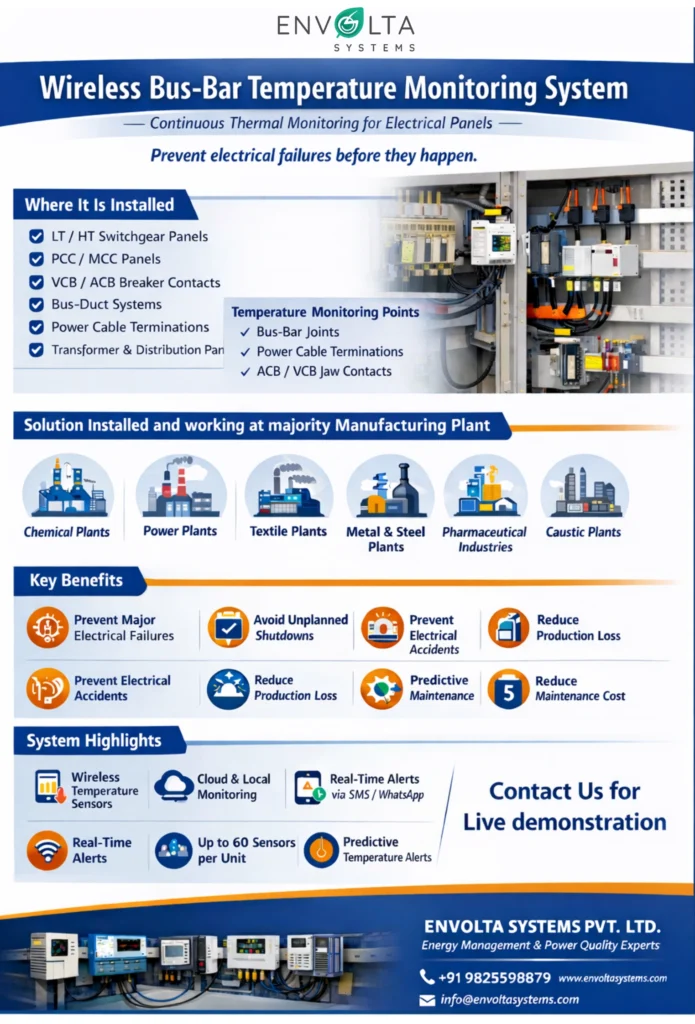
The Envolta Wireless Bus-Bar Temperature Monitoring System is designed for installation across the full range of electrical infrastructure found in industrial facilities. It is not limited to a single panel type or voltage class — it provides thermal visibility wherever heat-generating connections exist.
From an industrial maintenance engineering perspective, the shift from reactive to predictive maintenance is one of the most impactful transformations available to manufacturing facilities. Traditional electrical maintenance relies on periodic visual inspection, thermal imaging cameras during planned shutdowns, and reactive response to tripping events. All three approaches share a common weakness: they require the problem to become visible or to cause a fault before action is taken.
Wireless bus-bar temperature monitoring changes this paradigm fundamentally. By providing continuous, real-time thermal data from every critical connection point in the electrical infrastructure, it creates the data foundation for genuinely predictive intervention — catching a rising temperature trend at a bus-bar joint in week three, rather than responding to a bus-bar fire in week eight.
The SMS and WhatsApp alert delivery is also worth noting from a practical deployment standpoint. In most industrial plants, the personnel responsible for electrical infrastructure are not sitting in front of monitoring screens. They are mobile, managing multiple systems simultaneously. Delivering alerts through channels that operators actually use — rather than requiring them to check dedicated monitoring software — dramatically increases response speed and reduces the risk of missed alerts.
Every year, industrial plants across India and globally experience unplanned electrical failures that could have been prevented if a temperature anomaly had been detected weeks or months earlier. The Envolta Wireless Bus-Bar Temperature Monitoring System exists to close that gap — providing the continuous, wireless, real-time thermal intelligence that converts invisible warning signs into timely maintenance actions.
The case for implementation is straightforward: the cost of a single major electrical failure — in repair costs, production losses, and potential safety consequences — almost invariably exceeds the total cost of a comprehensive temperature monitoring system many times over. Prevention, in this context, is not just better than cure. It is dramatically more cost-effective.
Contact Envolta Systems for a live demonstration: +91 9825598879 | info@envoltasystems.com | www.envoltasystems.com

TF/24,25, Omkar-2, Nr. GIDC Bus Depot, Ankleshwar - 393002, Gujarat
GF/7,8,9, Samanvay Sequence, Manjalpur, Vadodara - 390011, Gujarat.


